
Bemotrizinol Sunscreen: What BEMT Means for Your Skin
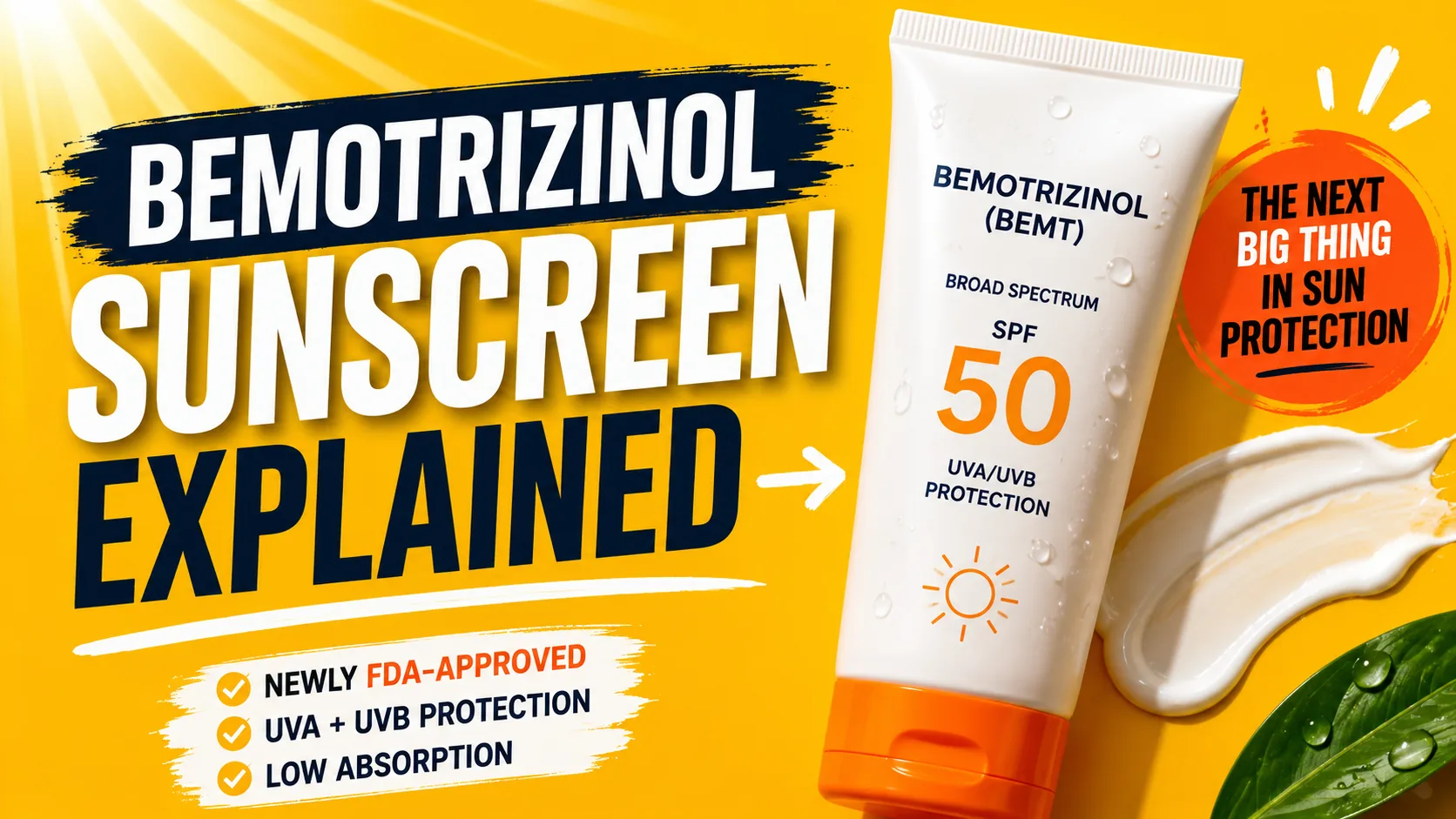
For the first time in decades, U.S. sunscreen options are expanding. The FDA has finalized an order that adds bemotrizinol, also called BEMT, to the over-the-counter sunscreen monograph under specific conditions. It is a meaningful change, but it is not a reason to throw away a sunscreen that already works for you.
Sunscreen questions can get confusing fast. Patients hear terms like chemical sunscreen, mineral sunscreen, broad spectrum, UVA, UVB, photostable, reef safe, and now bemotrizinol. The good news is still the same: you do not need to memorize sunscreen chemistry to protect your skin well.
The short answer
Should you switch to a BEMT sunscreen now?
No. Keep using a broad-spectrum, water-resistant sunscreen with SPF 30 or higher if it works for your skin. BEMT gives formulators another useful option, but the finished product still has to be tested, feel good enough to use consistently, and fit your skin and your plans.
What is bemotrizinol?
Bemotrizinol is an organic ultraviolet filter. You may also see it called BEMT or, on some international ingredient lists, bis-ethylhexyloxyphenol methoxyphenyl triazine. In everyday sunscreen language, it falls on the “chemical sunscreen” side of the mineral-versus-chemical divide.
UV filters reduce the amount of ultraviolet radiation that reaches and damages the skin. BEMT absorbs across both the UVB range and the UVA range. UVB is the main driver of sunburn. UVA contributes to tanning, premature skin aging, pigment changes, and skin cancer risk. Covering both matters, which is why the words broad spectrum on a finished sunscreen label are more useful than a high SPF number by itself.
BEMT is also highly photostable. That means the ingredient remains relatively stable when exposed to ultraviolet light. This can help formulators build reliable UVA and UVB protection and can help stabilize less photostable filters in a formula.
Photostable does not mean indestructible. Sunscreen still gets rubbed off by towels and clothing, diluted by sweat or water, applied too thinly, and missed altogether on spots like ears and the hairline. A BEMT sunscreen will still need to be applied generously and reapplied according to its label.
What the FDA changed, and when it takes effect
The familiar phrase “FDA approved” is useful shorthand here, but the regulatory path matters. The FDA did not approve one branded sunscreen through an individual new drug application. It amended the OTC sunscreen monograph through Final Administrative Order OTC000039 and determined that sunscreen products containing BEMT can be generally recognized as safe and effective, or GRASE, when they meet the order and other applicable requirements.
The BEMT regulatory timeline
June 9 and 10, 2026
The FDA announced the final action on June 9. Final Administrative Order OTC000039 is dated June 10 and adds BEMT to the sunscreen monograph under specified conditions.
August 9, 2026
The order states that it takes effect on this date unless it is disputed under the process described in federal law. This date is different from the June announcement.
Later in 2026
The American Academy of Dermatology says the first BEMT products are expected on U.S. shelves later in 2026. Permission to market a conforming product is not the same as immediate retail availability.
Under the order, BEMT may be used at concentrations up to and including 6%. The FDA reviewed use in adults and children 6 months of age and older. The order also addresses permitted filter combinations, skin-protectant combinations, dosage forms, labeling, and finished-product testing. In other words, “contains BEMT” is not a complete quality test by itself.
The order includes an 18-month period during which DSM Nutritional Products LLC, its licensees, assignees, or successors may market drugs incorporating the change. For shoppers, the practical point is simple: the ingredient may arrive through a limited group of suppliers and products first, then appear more broadly over time.
What the safety and absorption evidence says
The FDA concluded that there is adequate evidence of safety and effectiveness for BEMT at concentrations up to 6% under the monograph conditions, including use in adults and children 6 months and older. Its review included clinical efficacy studies, human safety studies, a maximum-use pharmacokinetic study, nonclinical studies, manufacturing information, and prior international use.
In the maximum-use study, 162 adults applied one of three 6% BEMT sunscreen formulations four times a day for four days over most of the body. The study was designed to push exposure higher than ordinary daily use. Systemic absorption was low overall and did not show meaningful accumulation. This supports the FDA’s conclusion, but it is not the same as saying zero absorption.
You may see the number 0.5 ng/mL in discussions of this study. That is not a general border between “safe” and “toxic.” FDA uses it as a regulatory threshold that helps determine whether certain additional nonclinical testing is needed. In the pivotal study, 3% of all plasma samples were at or above that level, usually sporadically. Mean concentrations across all participants remained below it at every time point, and the FDA considered the pharmacokinetic results together with the larger safety package.
No sunscreen ingredient is guaranteed never to irritate anyone. The FDA review found no material irritation, sensitization, phototoxicity, or photoallergenicity signal that changed its decision. A finished product can still contain fragrance, preservatives, solvents, or other ingredients that do not agree with a particular person’s skin.
The finished sunscreen matters more than one ingredient
A UV filter does not work in isolation. The finished sunscreen’s protection and wear depend on the filter combination, the concentration of each filter, how the product forms an even film, its vehicle, its water resistance, how much you apply, and whether you reapply it.
BEMT may give formulators more flexibility to build broad-spectrum products that are transparent on the skin and cosmetically elegant. “May” matters. BEMT does not guarantee that every product will be weightless, non-greasy, non-comedogenic, fragrance-free, invisible on every skin tone, or better than every mineral sunscreen. Those are properties of a finished formula, not automatic properties of the filter.
BEMT compared with mineral and other organic filters
The chemical-versus-mineral sunscreen debate can sound more dramatic than it needs to be. Both categories work mainly by absorbing UV radiation. Mineral filters also reflect a smaller portion. The most useful comparison is not “natural versus dangerous.” It is whether the finished product gives broad-spectrum protection, suits your skin, and is pleasant enough that you will use the right amount.
| Feature | Bemotrizinol (BEMT) | Zinc oxide or titanium dioxide | Other U.S. organic filters |
|---|---|---|---|
| Filter type | Organic, often called chemical | Inorganic, often called mineral or physical | Organic, often called chemical |
| UV coverage | Absorbs across UVA and UVB ranges | Coverage varies by filter and formula; zinc oxide has broad UVA and UVB coverage | Coverage varies by filter, so combinations are common |
| Photostability | Highly photostable and can help stabilize some other filters | The filters themselves are stable, but the full formula still matters | Varies; some filters need stabilizing support in the formula |
| Appearance and feel | Can support transparent, elegant formulas, but does not guarantee them | May feel thicker or leave a white cast; tint can improve appearance | Often transparent, but feel and tolerability depend on the vehicle |
| Best use | A promising additional option when a finished product fits the person’s skin and plans | A familiar option, often useful for sensitive skin and for people who prefer mineral filters | Established options that remain useful in well-formulated broad-spectrum products |
Choosing sunscreen for acne, sensitive skin, pigmentation, children, and pregnancy
Acne-prone skin
Texture and vehicle often matter more than the filter category. A fluid, gel, or lightweight lotion may be easier to wear than a heavy cream. “Non-comedogenic” is a useful starting label, not a promise that no one will break out. If a sunscreen pills, stings, or seems to worsen acne, try a different finished formula rather than assuming every mineral or organic filter will behave the same way. Our Acne 101 guide explains why acne varies from person to person.
Sensitive or rosacea-prone skin
Mineral sunscreens are often a good starting point because zinc oxide and titanium dioxide tend to be less irritating for sensitive skin. Fragrance, alcohol, preservatives, and the overall vehicle can still matter. BEMT’s low overall absorption does not automatically mean a BEMT formula will never sting or trigger a reaction.
Melasma, hyperpigmentation, and deeper skin tones
Transparent organic filters may help reduce the white cast that can make some mineral sunscreens difficult to wear on deeper skin tones. For melasma and other pigment concerns, remember that BEMT is a UV filter. It does not replace the visible-light protection that a tinted sunscreen with iron oxides can provide. Look for broad-spectrum SPF 30 or higher and consider a tint that matches your skin well enough to wear consistently.
Children
The final order supports BEMT use in sunscreen products intended for adults and children 6 months and older. For babies younger than 6 months, shade, protective clothing, and avoiding direct sun are the first steps, and the FDA label directs caregivers to ask a doctor. The AAD still recommends mineral filters as a practical starting point for infants and toddlers because they are less likely to irritate sensitive young skin.
Pregnancy and breastfeeding
The FDA’s BEMT order is not a special pregnancy recommendation. If a mineral sunscreen already works for you, there is no reason to switch because BEMT is new. Mineral sunscreen remains a familiar, widely available option during pregnancy and breastfeeding. Product-specific questions, a history of sunscreen allergy, or severe melasma are reasonable topics to discuss with your obstetric or dermatology clinician.
What to look for when BEMT sunscreens reach U.S. shelves
- Read the Drug Facts panel. Bemotrizinol should appear in the active-ingredients section of a U.S. sunscreen label. A trade name on the front is not enough.
- Choose broad-spectrum SPF 30 or higher. BEMT can cover UVA and UVB wavelengths, but the broad-spectrum claim and SPF belong to the tested finished product.
- Match water resistance to the day. Choose 40- or 80-minute water resistance for swimming, sweating, lake days, outdoor sports, or long gardening sessions, then follow the label for reapplication.
- Look beyond the filter list. Fragrance, tint, texture, finish, eye sting, packaging, and price all affect whether the sunscreen will become a real habit.
- Do not assume “new” means “best.” A BEMT sunscreen can be an excellent choice. So can a mineral, organic, or hybrid sunscreen that already meets the protection basics and works for you.
As of August 4, 2026, the order’s stated effective date has not yet arrived, and the AAD says the first U.S. products are expected later in 2026. International products containing BEMT already exist, but their filters, labels, claims, and distribution may not match U.S. monograph requirements. You do not need to import a product or pause sun protection while waiting.
How to use sunscreen well, with BEMT or without it
- Choose the protection basics. Use broad-spectrum, water-resistant SPF 30 or higher on skin that clothing does not cover.
- Apply enough. Most adults need about 1 ounce to cover exposed body skin. For the face, the AAD advises at least about 1 teaspoon. Body size and the amount of exposed skin change the total.
- Apply before exposure. Put sunscreen on about 15 minutes before going outdoors and remember ears, neck, tops of feet, hands, hairline, exposed scalp, and lips.
- Reapply in real life. Reapply about every two hours outdoors and after swimming, heavy sweating, or toweling off. Follow the 40- or 80-minute interval on a water-resistant label.
- Use more than sunscreen. Add shade, hats, sunglasses, and sun-protective clothing. Sunscreen is part of the plan, not permission to stay out indefinitely.
That advice applies on a Minnesota lake, at kids’ sports, while gardening, and during winter activities around reflective snow. For a cold-weather version of the routine, see our guide to sunscreen in winter and snow.
What about “reef safe” claims?
“Reef safe” is not a defined FDA sunscreen label, and it is too simple to treat any one ingredient as automatically safe or unsafe for every aquatic environment. Environmental effects depend on concentration, formulation, amount used, water conditions, and the ecosystem being studied. The AAD describes the current evidence about sunscreens and reefs as limited and calls for more research.
For skin health, unprotected UV exposure remains a well-established risk. If environmental impact is important to you, combine a sunscreen you can use with shade, clothing, hats, and thoughtful timing outdoors. Those steps reduce both UV exposure and the amount of sunscreen needed on covered skin.
Frequently asked questions
Are BEMT, bemotrizinol, Tinosorb S, and PARSOL Shield the same thing?
Bemotrizinol is the ingredient’s generic name, and BEMT is its common abbreviation. Tinosorb S and PARSOL Shield are supplier trade names for bemotrizinol. On a U.S. sunscreen’s Drug Facts panel, look for bemotrizinol in the active-ingredients list rather than relying on a trade name on the front of the package.
Does a higher percentage of BEMT make a sunscreen better?
Not automatically. The FDA order permits bemotrizinol at concentrations up to and including 6%, but a percentage does not tell you the finished product’s SPF, UVA protection, water resistance, texture, or tolerability. Compare the complete tested sunscreen, not one number in its active-ingredients list.
Does BEMT replace avobenzone?
Not necessarily. BEMT can be formulated with other permitted sunscreen filters, and its photostability can help support filters such as avobenzone. Some future products may contain both, while others may use a different permitted combination. What matters to the shopper is the finished product’s broad-spectrum label, SPF, water resistance, and real-world fit.
The bottom line
BEMT is a welcome new tool. It offers broad UVA and UVB coverage, high photostability, low overall systemic exposure in the evidence reviewed by the FDA, and useful formulation possibilities. It does not make every existing sunscreen obsolete, and it does not turn one active ingredient into a complete product recommendation.
The best sunscreen is still one that provides broad-spectrum SPF 30 or higher, fits the day, agrees with your skin, and gets used generously and consistently. If that describes the sunscreen you already own, keep using it.
When sunscreen choice is not simple
A dermatology visit can help if sunscreen reactions, acne, rosacea, melasma, a history of skin cancer, or a child’s sensitive skin make trial and error difficult. Bring the product or a photo of its Drug Facts panel so the conversation can stay practical.
Related Scenic Dermatology resources
- Sunscreen in winter and snow: a guide for Minnesotans
- Acne 101: what’s happening under your skin
- Skin checks and mole checks at Scenic Dermatology
Sources
- U.S. Food and Drug Administration: FDA expands sunscreen options for the first time in 20 years
- FDA Final Administrative Order OTC000039
- FDA scientific review supporting the BEMT administrative order
- American Academy of Dermatology Association: statement on the new sunscreen ingredient
- American Academy of Dermatology: how to decode a sunscreen label
- American Academy of Dermatology: how to apply sunscreen
- Preliminary clinical pharmacokinetic evaluation of bemotrizinol
- dsm-firmenich: PARSOL Shield trade-name information
- BASF: Tinosorb S trade-name information