
Psoriasis Treatment Options: From Topicals to Phototherapy
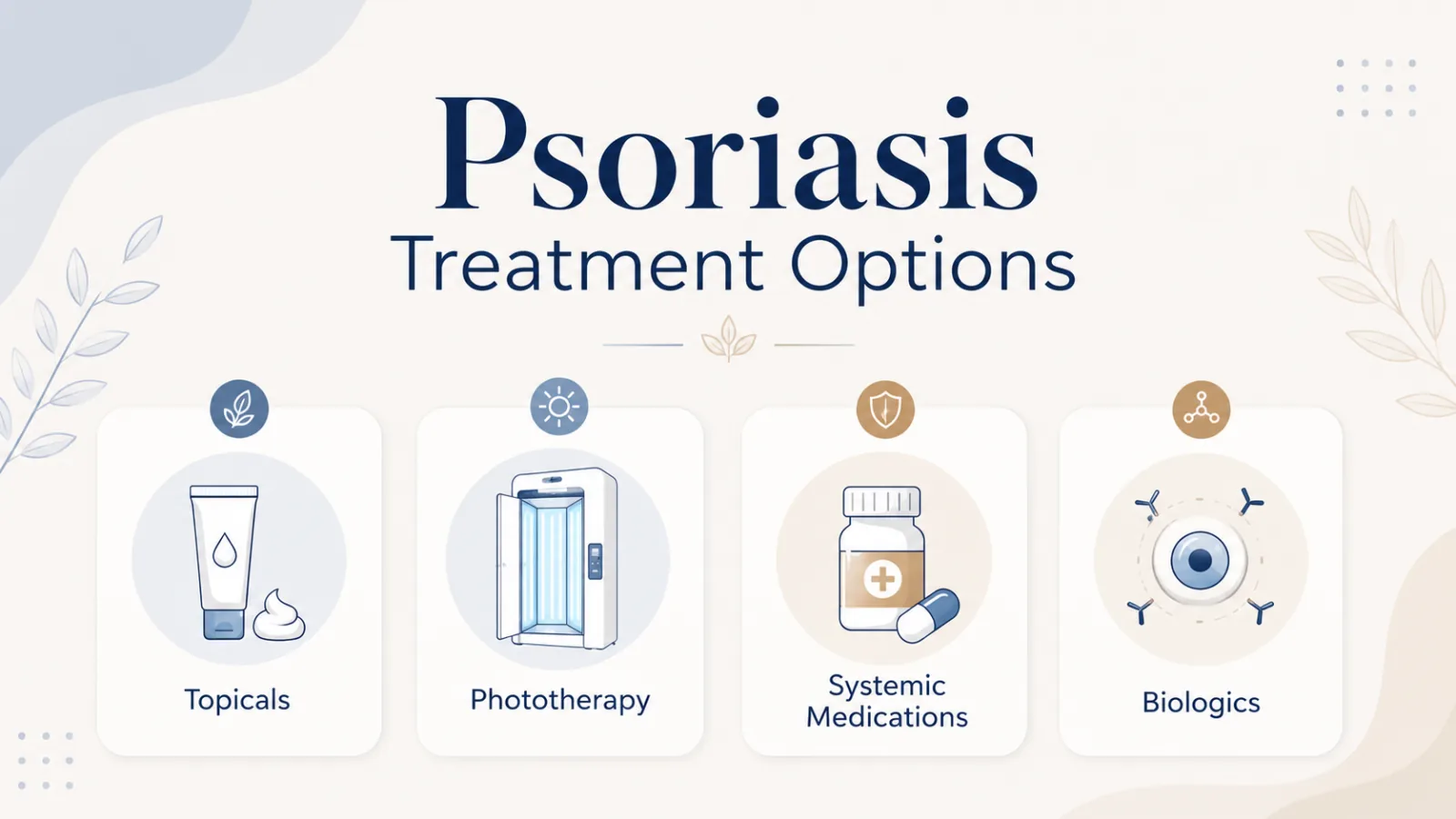
Psoriasis treatment is not one-size-fits-all. The right plan depends on the type of psoriasis, where it appears, how much skin is involved, your symptoms, your overall health, and how previous treatments have worked for you.
This guide explains the major psoriasis treatment options—from topical medications and phototherapy to systemic medications and biologics—plus why scalp, nail, genital, palm, sole, and joint symptoms can change the conversation. The goal isn’t simply to “try a cream.” It’s to find an effective plan that is safe, practical, and realistic to keep up with.
Psoriasis treatment options at a glance
Most treatment plans fit into four broad categories. Some people need only one; others do better with a combination. This comparison is a starting point, not a prescribing formula.
| Treatment | Where it often fits | Practical tradeoff |
|---|---|---|
| Topical medications | Focused plaques, scalp symptoms, or sensitive and high-impact areas; also used alongside other treatments | Application is local, but daily routines can be messy or hard to sustain over large areas |
| Phototherapy | Multiple areas, thicker plaques, or psoriasis that has not improved enough with topicals | Can avoid a whole-body medication, but usually requires repeated, scheduled sessions |
| Systemic medications | Widespread, painful, stubborn, disabling, or joint-involved psoriasis | Convenient pills may be available, but risks, pregnancy considerations, and monitoring vary widely |
| Biologics | Moderate-to-severe psoriasis, psoriatic arthritis, or disease not controlled with other approaches | Targeted and often powerful, but require injections or infusions, infection screening, and ongoing follow-up |
What shapes the treatment choice?
Psoriasis is a chronic inflammatory disease. Plaque psoriasis is the most common type, but psoriasis can also affect the scalp, nails, folds of skin, genitals, hands, feet, and joints. Two people with the same amount of visible skin involvement may need very different plans.
Psoriasis can also resemble eczema, seborrheic dermatitis, a fungal infection, or another rash—especially on the scalp, in folds, or around a changed nail. Confirming the diagnosis matters before escalating treatment or reusing a prescription that was meant for a different problem.
A dermatologist may consider:
- How much skin is affected and whether the pattern is plaque, guttate, inverse, pustular, or another type
- Whether plaques are thick, painful, itchy, cracking, bleeding, or interfering with sleep and movement
- Whether psoriasis affects high-impact sites such as the scalp, nails, genitals, palms, or soles
- How much symptoms interfere with work, exercise, clothing choices, confidence, and daily life
- Whether joint pain, swelling, stiffness, tendon pain, or heel pain could suggest psoriatic arthritis
- Other health conditions, current medications, infection history, vaccination needs, and pregnancy or breastfeeding plans
- What has or has not worked before
- Your comfort level with creams, light therapy, pills, injections, infusions, laboratory monitoring, cost, and travel to treatment
Severity is more than a percentage of skin. A small area on the hands, feet, genitals, scalp, or nails can have an outsized effect on daily life and may justify a different approach than its size alone would suggest. Preference matters too: a treatment that works on paper but does not fit your routine is unlikely to be the best long-term plan.
Topical treatments for psoriasis
Topical treatments are medications applied directly to the skin. They are often used for mild or localized psoriasis, scalp psoriasis, sensitive-area psoriasis, or as part of a combined plan with phototherapy or systemic treatment.
Topical corticosteroids
Topical corticosteroids can reduce redness, itching, scaling, and inflammation. They come in different strengths and formulations, including creams, ointments, foams, lotions, gels, oils, and scalp solutions. Stronger steroids may be used for thicker plaques or tougher areas, while gentler options are usually chosen for the face, folds, genitals, or skin that is thinner.
Potency, location, and duration matter. Overuse can cause problems such as skin thinning, stretch marks, or visible blood vessels, so long-term use should follow a dermatologist-directed plan rather than an open-ended “use as needed” routine.
Vitamin D analogues, retinoids, and nonsteroid options
Vitamin D analogues can help slow excess skin-cell growth and are often used alone or with topical steroids. Topical retinoids can help normalize skin-cell turnover and reduce scaling, although irritation limits where and how they are used.
Nonsteroid prescriptions can be especially useful when repeated steroid use is not ideal. Depending on the diagnosis, site, age, and other factors, a dermatologist may consider a calcineurin inhibitor or another nonsteroid anti-inflammatory medication. These choices are not interchangeable, and some are used off-label in selected areas.
Scale-softening and moisturizing care
Salicylic acid, coal tar, and emollients may help soften scale or support another treatment. Moisturizer does not treat the underlying inflammation by itself, but it can reduce dryness and make cracking, itching, and scaling more manageable—particularly during a cold, dry Minnesota winter.
Best fit: Topicals are often useful for limited psoriasis and specific high-impact sites. They may not be enough when disease is widespread, very thick, painful, difficult to reach, affecting joints, or taking over too much of daily life.
Phototherapy for psoriasis
Phototherapy uses controlled ultraviolet light to slow the overactive skin and immune processes involved in psoriasis. It is different from casual sun exposure or a tanning bed. Medical phototherapy uses a selected wavelength, a measured dose, a schedule, protective steps, and clinical supervision.
Narrowband UVB
Narrowband UVB phototherapy, often shortened to NB-UVB, uses a focused range of ultraviolet B light. It is a common option for plaque psoriasis and may be considered when topicals are not enough, when multiple areas are involved, or when a skin-directed treatment fits better than a systemic medication.
NB-UVB is not instant. It usually requires repeated visits each week for a series of treatments, followed by reassessment. Sessions themselves can be brief, but travel, scheduling, missed visits, and the cumulative time commitment are real parts of the decision.
PUVA
PUVA combines UVA light with psoralen, a medication that makes the skin more sensitive to the light. Psoralen may be taken by mouth or used in a bath or topical form. PUVA can be effective in selected cases, but the added medication, photosensitivity precautions, eye protection, and cumulative skin-cancer risk make it a more complex option than NB-UVB. It is used less routinely and requires careful selection and follow-up.
Excimer laser and targeted UVB
An excimer laser delivers targeted UVB to specific plaques while limiting exposure to surrounding skin. That can make sense for a few stubborn, localized areas, including some scalp or high-impact sites. It is generally less practical for widespread psoriasis because each treatment is directed spot by spot.
Phototherapy risks and limits
Short-term effects can include redness, tenderness, itching, dryness, stinging, burns, blisters, or pigment changes. Long-term UV exposure can contribute to freckles and premature skin aging; skin-cancer risk depends on the modality and cumulative exposure and is a particularly important concern with PUVA. A history of skin cancer, a condition that causes UV sensitivity, or a medication that increases photosensitivity may change whether phototherapy is appropriate.
Tanning beds are not a substitute. Their output is not the same as a dermatologist-prescribed protocol, and they add avoidable UV risk without the same dosing control or follow-up.
Systemic medications and biologics
When psoriasis is moderate to severe, widespread, painful, resistant to topical treatment, associated with joint disease, or significantly affecting quality of life, a dermatologist may discuss medication that works throughout the body.
Nonbiologic systemic medications
Systemic medications include pills such as methotrexate, cyclosporine, acitretin, apremilast, and deucravacitinib. They do not all work the same way. Some broadly affect immune activity, some target a narrower signaling pathway, and acitretin is a retinoid rather than an immune-suppressing medication.
The tradeoffs differ just as much. Depending on the medication, a plan may involve blood-pressure checks, laboratory monitoring, liver or kidney considerations, medication interactions, infection precautions, or limits on how long the drug is used. Acitretin can cause severe birth defects and is not an option during pregnancy; its pregnancy-prevention requirements extend well beyond the last dose. Pregnancy plans need to be discussed before—not after—choosing treatment.
Biologics
Biologics are targeted medications that affect specific immune pathways involved in psoriasis. They are often considered for moderate-to-severe psoriasis, psoriatic arthritis, or psoriasis that has not responded well enough to other treatments. Some are self-injected; others are given by infusion.
Biologics can be powerful tools, but they are not automatically the best choice for every patient. Selection can depend on skin and joint disease, medical history, inflammatory bowel disease or other health conditions, previous treatment response, infection risk, pregnancy plans, medication schedule, insurance coverage, and preference.
Before starting a biologic, clinicians typically review infection history and obtain screening that may include blood tests and tuberculosis testing. Ongoing testing and vaccine planning depend on the specific medication and the person taking it. Contact the prescribing clinician about a significant infection, new side effect, pregnancy, or planned vaccine rather than changing or stopping a biologic on your own.
Phototherapy or a biologic?
These treatments are not interchangeable. Phototherapy is directed mainly at treated skin and avoids taking a medication throughout the body, but it asks for repeated visits and still carries cumulative UV considerations. A biologic works internally and may address both skin and joint disease, but it brings medication-specific screening, infection considerations, injections or infusions, and insurance logistics. The best choice depends on the person, not just the diagnosis.
Treatment changes with the body site
Some areas need a more tailored plan. A medication that works well on a thick elbow plaque may be too strong, too greasy, or simply impossible to use on another part of the body.
Scalp psoriasis
Hair can make creams and ointments difficult to apply. Medicated shampoos, oils, foams, gels, solutions, vitamin D-based medications, and nonsteroid options can make treatment easier to get through the hair and onto the scalp. Scale-softening treatment may help another medication reach the skin. Targeted light or systemic treatment may be considered when scalp disease is extensive or stubborn.
Nail psoriasis
Nail psoriasis can cause pitting, lifting, thickening, discoloration, crumbling, and tenderness. It can resemble a fungal infection, and the two can occur together, so confirming the diagnosis matters. Because nails grow slowly, visible improvement takes time. Options may include topical treatment, injections near the nail unit in selected cases, or systemic treatment when nail disease is extensive or part of broader psoriasis.
Inverse and genital psoriasis
Psoriasis in skin folds, the groin, underarms, under the breasts, or on genital skin often has less scale and more irritation because the skin is thin and rubs together. Treatment usually relies on lower-potency or nonsteroid topicals chosen for the site. A product prescribed for a thick plaque elsewhere may be harmful in this area, so avoid simply transferring the same routine.
Palms and soles
Thick plaques, cracks, or pustules on the hands and feet can make walking, gripping, and working painful even when the total area is small. Stronger topicals, occlusion, phototherapy, or systemic treatment may be considered depending on the exact diagnosis and severity.
Pay attention to joint and tendon symptoms
Psoriasis can affect more than skin. Psoriatic arthritis can involve joints, tendons, and the places where tendons attach to bone. An article cannot diagnose it, but skin-treatment decisions should not ignore possible joint disease.
Tell a clinician about new joint, tendon, or heel symptoms
Ask for medical evaluation if you have persistent joint pain or swelling, morning stiffness that improves as you move, a noticeably swollen finger or toe, heel pain, or swelling and pain around the Achilles tendon. A dermatologist, primary-care clinician, or rheumatologist can help sort out the cause. Earlier recognition matters because treatment can help prevent lasting joint damage.
Triggers, diet, supplements, and realistic expectations
Triggers do not cause psoriasis, but they can aggravate it in someone who already has the disease. Common examples include infection, stress, skin injury, smoking, heavy alcohol use, certain medications, and environmental stressors. Cold, dry Minnesota weather can also worsen dryness, itching, cracking, and the practical burden of a topical routine.
Psoriasis cannot be cured by a detox, supplement, or single food change. Research on many diets and supplements is limited or conflicting. Healthy habits—such as not smoking, limiting alcohol, maintaining a weight that supports overall health, managing stress, moisturizing, and treating relevant health conditions—can be worthwhile, but they do not replace psoriasis treatment.
Be cautious with products that promise a cure. Even good medical treatment often involves adjustment: a medication may take weeks or months to show its full effect, one option may lose effectiveness over time, and a combination can work better than a single treatment. The useful goal is durable control with a burden and risk profile that makes sense for you.
A visit can help sort out the tradeoffs
If psoriasis is painful, persistent, affecting a high-impact area, interfering with daily life, or not responding to your current routine, a dermatology visit can help confirm the diagnosis, check skin, scalp, nails, and joint symptoms, and compare treatment choices against your health history and priorities.
Frequently asked questions
How long does psoriasis treatment take to work?
It depends on the treatment and what “working” means for you. Some topicals reduce itch or inflammation relatively quickly, while clearing thicker plaques, growing out a healthier nail, or completing a phototherapy series can take much longer. Systemic medications and biologics also have different expected timelines. Ask what change should be visible by a specific follow-up point before deciding a treatment has failed.
Can psoriasis treatments be combined?
Yes. A topical may be used with phototherapy or a systemic medication, and different topicals may be assigned to different body sites. Combination treatment can improve control or reduce reliance on one option, but the details matter—especially with photosensitizing products, strong steroids, and immune-active medication.
Is a small patch always mild psoriasis?
No. The total area matters, but so do pain, cracking, sleep loss, and location. Psoriasis on the genitals, scalp, nails, palms, or soles can have a major effect despite involving little skin. Joint or tendon symptoms also change the treatment discussion regardless of skin area.
Sources
- American Academy of Dermatology: Psoriasis clinical guideline
- American Academy of Dermatology: Psoriasis diagnosis and treatment
- American Academy of Dermatology: Psoriasis treatment—phototherapy
- American Academy of Dermatology: Psoriasis treatment—biologics
- American Academy of Dermatology: Psoriatic arthritis symptoms
- Joint AAD–NPF guideline: Topical therapy and alternative medicine
- Joint AAD–NPF guideline: Phototherapy
- Joint AAD–NPF guideline: Systemic nonbiologic therapies
- Joint AAD–NPF guideline: Biologics
- FDA prescribing information and Medication Guide: Acitretin