
Your Skincare Routine Might Be Why Everything Stings
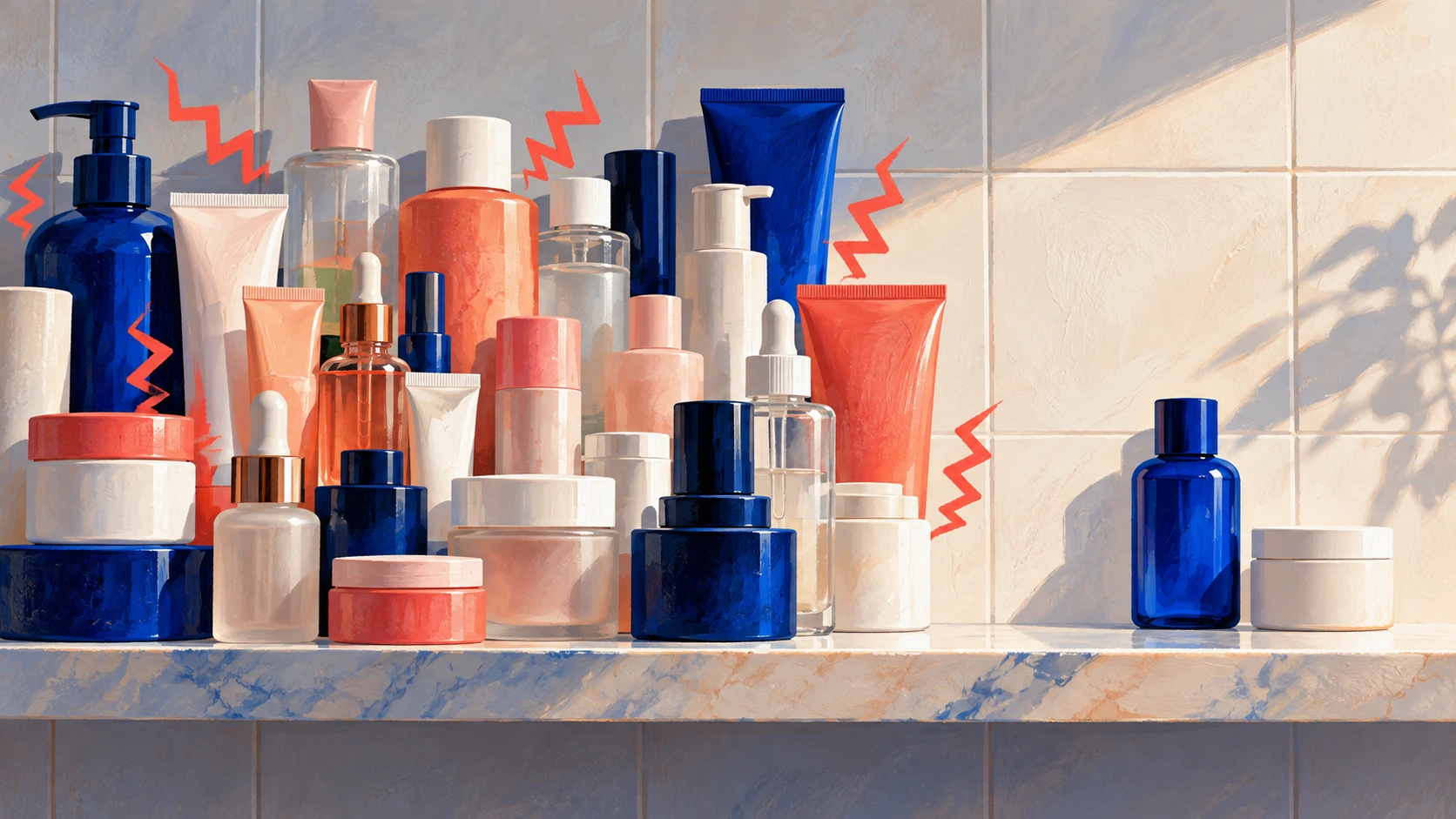
Your cleanser leaves your face tight. The serum you bought to help starts to burn. Then even your usual moisturizer stings, and you’re left wondering whether your skin has suddenly become allergic to everything.
Sometimes the routine itself is part of the problem. Repeated cleansing, exfoliating, and treatment steps can add up to more irritation than your skin tolerates. Adding another “soothing” product may keep the cycle going.
But stinging has several possible explanations, including contact allergy, rosacea, and other inflammatory skin conditions. The useful next step is to simplify what you can, look at the pattern, and know when an examination will answer more than another purchase.
Why products that used to feel fine can suddenly sting
The outer layer of your skin helps hold water in and limit contact with irritating substances. Repeated irritation can interfere with that barrier. Skin may become dry, tight, flaky, tender, or unusually reactive.
That can happen gradually. An exfoliating cleanser, an acid toner, a retinoid, and a scrub may each seem reasonable when considered separately. Together, or used too frequently, they may become difficult to tolerate. The American Academy of Dermatology specifically cautions that exfoliating alongside retinol, prescription retinoids, or benzoyl peroxide can worsen dryness and irritation.
It helps to ask what changed beyond the product name:
- Did you start using something every night instead of occasionally?
- Did you increase the strength or the amount?
- Did you add a second product doing a similar job?
- Are you washing, rubbing, or scrubbing more?
Controlled human research supports the idea that repeated irritant exposure can impair barrier function. Those experiments do not tell us how any particular facial routine will behave, but they help explain why the total exposure matters. There is no universal safe number of bottles.
What the recent “glass skin” research actually tells us
A September 30, 2026 EADV Congress press release described an analysis of 38 selected TikTok videos about Korean skincare and “glass skin.” Almost 95% contained at least one potentially misleading claim, and only one mentioned irritation risk.
Those numbers describe that small, selected sample. They cannot be applied to every skincare video, and the study did not test whether watching the videos caused skin disease.
A separate study described 94 patients who already had a new or worsened skin problem after using social-media-promoted products. Because these were selected symptomatic patients, it cannot tell us how often those products cause problems among everyone who uses them.
These are preliminary conference findings. The practical concern is advice that leaves out skin type, dose, frequency, and what to do when irritation starts. A product’s Korean origin does not determine whether your skin will tolerate it.
Irritation, allergy, and rosacea can feel similar
Irritant contact dermatitis: the exposure is too much
Irritant dermatitis develops when an exposure directly irritates or injures the skin. It can follow one harsh exposure or repeated smaller ones. Burning, tightness, dryness, and scaling may be prominent, but itching can occur too. Anyone can develop it under the right conditions.
The AAD’s contact dermatitis guidance explains that even repeated water and soap exposure can contribute. The word “gentle” on a label cannot account for how often a product is used or what else is in the routine.
Allergic contact dermatitis: a delayed immune reaction
Contact allergy involves an immune response to a particular substance. An itchy, swollen, scaly rash may develop hours or days after exposure. Fragrances, preservatives, and other product ingredients can be involved. A product you tolerated for months or years can still become relevant.
Appearance and timing provide clues, but they do not reliably separate every allergic reaction from irritation. Scenic’s contact dermatitis guide explains the distinction in more detail.
If a rash repeatedly affects the eyelids, also consider what reaches them from your hands, hair, or nail products. Our eyelid dermatitis product guide walks through those less obvious exposures.
Rosacea or another skin condition: the routine may be aggravating it
Rosacea can cause facial warmth, flushing, persistent color change, acne-like bumps, and burning or stinging. Some people also have dry, gritty, or irritated eyes. Color changes can be subtler in darker skin, so sensation and the overall pattern matter.
A simplified routine may improve comfort, while the underlying condition still needs treatment. Our rosacea guide explains what an evaluation looks for. Eczema and other conditions can also contribute, and more than one problem can coexist.
“Purging” should not explain away a painful rash
Some acne treatments can make acne appear worse early in treatment. For example, adapalene’s labeling describes early worsening and temporary irritation. It also warns about severe irritation and using more than directed.
That does not make every breakout, swollen eyelid, itchy patch, or burning face an adjustment you should endure. Persistent burning, rawness, swelling, or a spreading rash needs reassessment. How much a product stings is not a useful measure of how well it is working.
For a prescribed treatment, contact the clinician who prescribed it about what you are experiencing and how to adjust the plan. Do not stop medically necessary treatment based only on this article. Severe reactions or the warning signs below need prompt care.
A practical reset when your routine starts to sting
For mild irritation, the first goal is a comfortable, manageable routine. You do not need to replace your entire shelf.
1. Pause the optional steps that may be adding irritation
Set aside nonessential scrubs, peels, exfoliating toners, and recently added cosmetic treatments, especially anything that repeatedly burns. Avoid adding several new “barrier repair” products at once. The AAD recommends starting with one anti-aging product and stopping irritating cosmetic products, with prescriber guidance for prescription treatments.
This is a temporary simplification. Retinoids, exfoliating acids, and other active ingredients can be useful when the product, frequency, and combination fit the person.
2. Make cleansing less demanding
Use a mild, non-abrasive cleanser, lukewarm water, and your fingertips. Rinse thoroughly and pat dry. Put away cleansing brushes and avoid trying to scrub flakes off. The AAD’s face-washing guidance favors gentle handling and discourages extra washing.
3. Choose a moisturizer your skin accepts
A fragrance-free cream is a reasonable starting point for dry, reactive skin, particularly if you already know you tolerate it. Ingredients such as glycerin or ceramides can be helpful, but the entire formula matters. Price and a “sensitive skin” label cannot guarantee comfort.
“Unscented” does not necessarily mean fragrance-free, and botanical or essential-oil ingredients can still cause reactions. The AAD’s moisturizer guidance explains how formulation and skin type affect the choice.
If a moisturizer repeatedly burns or worsens the rash, avoid repeatedly testing it on inflamed skin. Ask for help selecting an alternative rather than cycling through more products.
4. Keep sun protection in the plan
Use shade, a broad-brimmed hat, and a tolerated broad-spectrum, water-resistant sunscreen with SPF 30 or higher. If sunscreen stings, a fragrance-free formula with zinc oxide, titanium dioxide, or both may be easier to tolerate. The AAD recommends these options for rosacea-prone skin. Individual formulas still vary; persistent intolerance deserves guidance.
5. Watch the direction of change
Are washing and moisturizing becoming more comfortable? Is tenderness or scaling easing? Keep a short record of products, frequency, symptoms, and any changes. Photograph a changing rash for your clinician if useful.
There is no dependable “three-day barrier repair” deadline. Arrange an evaluation if symptoms are worsening, remain troublesome despite simplification, or return whenever you try to resume normal care. Significant pain, swelling, or eye symptoms should not wait for a skincare experiment.
Bring products back with a reason for each one
Once your skin is comfortable, decide which concern you actually want to treat. Reintroduce optional products individually, following their directions and your clinician’s advice. Changing several things at once makes it harder to identify the cause if symptoms return.
For a new product, the AAD suggests a small-area home trial over seven to ten days. Follow the product’s normal contact time and directions. A tolerated trial reduces uncertainty but cannot guarantee that your face will tolerate it. Do not deliberately retry a product that caused a significant reaction without medical advice.
A comfortable supporting routine can make useful treatment easier to tolerate. In a manufacturer-funded randomized study of 88 people using adapalene/benzoyl peroxide, one supportive skincare regimen produced less discomfort than the comparison routine at two weeks; acne improved in both groups. The trial tested specific products and does not establish one universal combination.
When to get medical help
- Call 911 for trouble breathing or swallowing, throat or tongue swelling, or a rapidly developing severe allergic reaction.
- Seek prompt medical care for substantial facial or eyelid swelling, blistering, raw or open skin, fever, spreading pain, or a rapidly worsening rash. Sudden eye or lip swelling may need emergency care.
- Seek same-day eye assessment for eye pain, new vision changes, or marked light sensitivity. Go to an emergency department if urgent eye care is unavailable.
The AAD’s rash warning signs can help you recognize when home care is not enough.
For persistent or recurring reactions, a dermatologist can review the full routine, examine the pattern, and decide whether treatment or formal patch testing would help. Patch testing investigates delayed contact allergy. It does not diagnose ordinary irritation, and a home product trial is a different process.
Common questions
Does stinging mean I permanently damaged my skin?
Stinging alone cannot tell you the cause or predict permanent damage. Many irritant reactions improve when the exposure is reduced and the skin receives appropriate care. Persistent symptoms deserve an examination.
Can I be allergic to a product I have used for years?
Yes. Contact allergy can develop after previous tolerance. The current ingredient list and the timing of the rash can help your dermatologist investigate.
Should I stop every active ingredient forever?
No. A temporary reset can help during irritation. Longer-term choices depend on the diagnosis, what you are treating, and what your skin tolerates. Review prescribed treatments with your clinician.
Get a clearer plan for reactive skin
Scenic Dermatology is an independent, physician-owned practice in Chaska, Minnesota. If your routine keeps leaving your skin uncomfortable, request a dermatology appointment or call (952) 520-5000. Bring your products or current ingredient-label photos and a brief timeline. Online requests require confirmation from the practice.
Selected sources
- European Academy of Dermatology and Venereology. September 30, 2026 press release on two EADV Congress studies. Preliminary conference findings.
- American Academy of Dermatology. Contact dermatitis causes; patch testing; and skincare guidance linked throughout this article.
- Angelova-Fischer I, et al. Cumulative irritant exposure and skin-barrier function. Acta Derm Venereol. 2014;94:640–644.
- Khammari A, et al. Supportive skincare during adapalene/benzoyl peroxide treatment: randomized trial. J Cosmet Dermatol. 2024;23:1313–1319.
- DailyMed. Adapalene gel 0.1% consumer labeling.