
Keratosis pilaris care · Chaska, Minnesota
Keratosis Pilaris Diagnosis and Treatment
Those rough bumps on the upper arms or thighs are often harmless keratosis pilaris. Treatment is optional. If the texture, dryness, itch, color, or appearance bothers you, a simple and tolerable routine usually makes more sense than trying to scrub every bump away.
Keratosis pilaris—often called KP or “chicken skin”—is a follicular plugging tendency. It is not acne, an infection, trapped dirt, or a sign of poor hygiene. Scenic Dermatology evaluates rough or acne-like bumps in children, teenagers, and adults when the diagnosis is uncertain or a practical plan would help.
Quick orientation
Common. Harmless. Not contagious. Understandably frustrating. Treatment optional.
- Small plugs form at hair-follicle openings.
- Dry skin often makes the texture more noticeable.
- Moisturizer and gentle keratin-loosening treatment can help.
- More exfoliation is not necessarily better.
The follicle explains the texture
What Is Keratosis Pilaris?
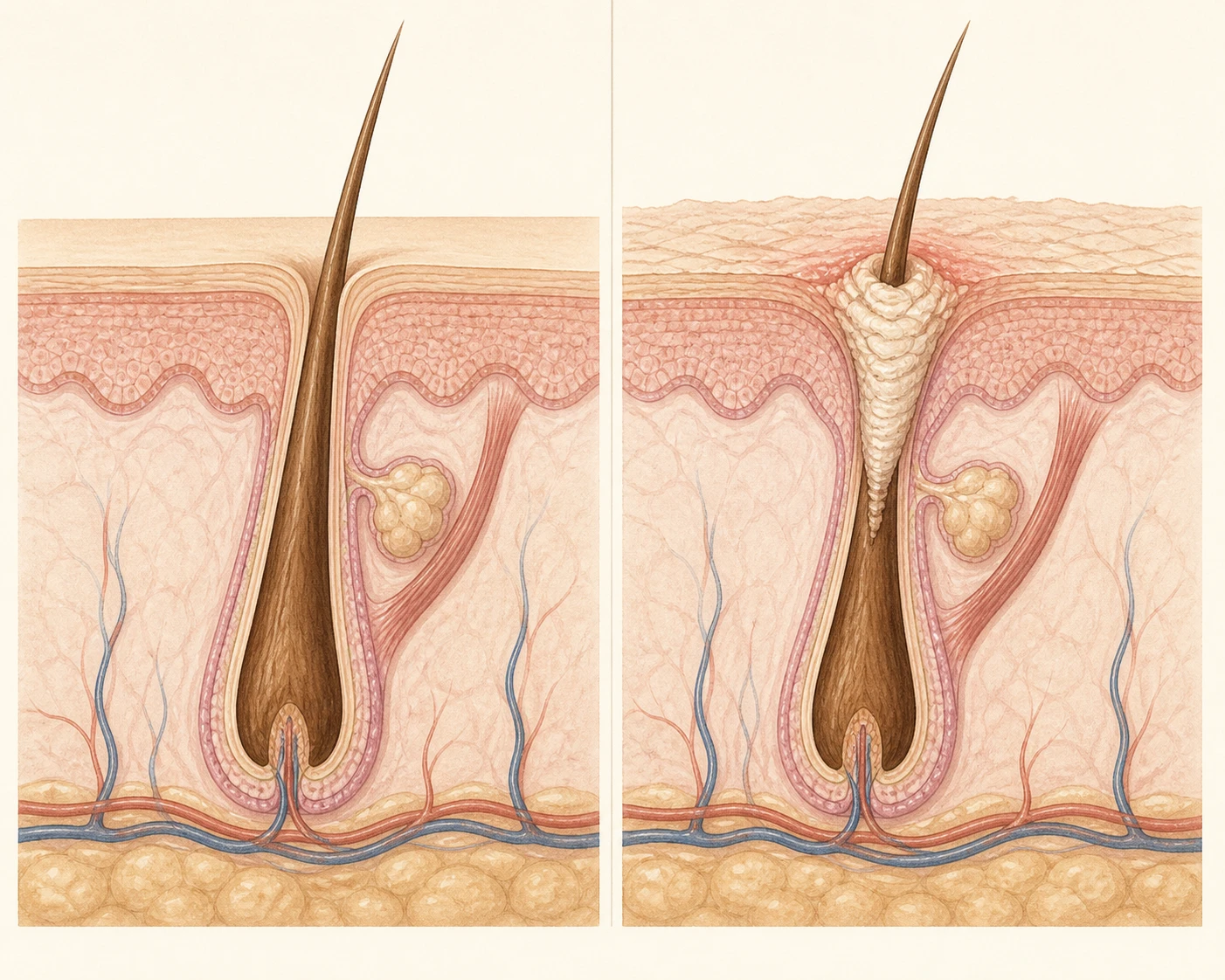
Hairs grow from follicles. In keratosis pilaris, keratin—one of the proteins in the outer skin—accumulates around and within the follicular opening. The compact plug creates a tiny bump and a sandpaper-like surface. Dry scale around the opening can make the texture easier to feel.
Some follicles also become mildly inflamed, adding itch, redness, purple or brown color, or darker marks. That variation is why KP should not be described only as “red bumps.” The bumps may be skin-colored, white, pink, red, purple, brown, or darker than the surrounding skin.
KP often begins in childhood, may become especially noticeable around adolescence, and can continue into adulthood. It commonly appears on the outer or back upper arms, thighs, buttocks, and children’s cheeks. Many people notice gradual improvement with age, but no timeline applies to everyone.
Typical clues, not a photo diagnosis
Keratosis Pilaris, Acne, or Folliculitis?
These conditions can all produce bumps near follicles, and a person can have more than one at the same time. Distribution, surface texture, tenderness, pustules, comedones, inflammation, and treatment response help a dermatologist distinguish them.
| Possibility | Typical clues | Why the distinction matters |
|---|---|---|
| Keratosis pilaris | Dry, rough follicular plugs; often on upper arms or thighs; usually not tender or pustular. | KP is harmless, not infectious, and treatment is optional. |
| Acne | Blackheads or whiteheads may occur with inflamed papules, pustules, or deeper nodules. | Acne has different biology, scar risk, and treatment. KP elsewhere does not rule acne in or out. |
| Folliculitis | More inflamed follicular bumps that may be tender or pustular; causes include infection, irritation, occlusion, or shaving. | Pain, pustules, crusting, or rapid worsening can require a different evaluation and plan. |
Scenic’s acne care guide explains comedones and inflammatory acne in more depth. If bumps are painful, pus-filled, crusted, rapidly worsening, or behaving unlike ordinary rough KP, another diagnosis may be more likely.
“Strawberry legs” is not a precise diagnosis. The phrase may describe visible follicular openings, KP, shaving irritation, folliculitis, ingrown hairs, pigment, retained debris, or another follicular change. It is not a reliable synonym for keratosis pilaris.
Start with your goal
Do You Actually Need to Treat KP?
No. KP does not need medical treatment simply because it exists. Observation is a sound choice when the bumps are not uncomfortable or bothersome. Treatment may be worthwhile when someone wants help with roughness, dryness, itch, inflammation, color change, or appearance.
Rough texture
Moisturizer plus one gentle keratolytic may help loosen retained keratin.
Dryness or itch
Barrier-focused care may matter more than stronger exfoliation.
Redness or inflammation
Reducing irritation comes first; selected inflammatory symptoms may need a different plan.
Darker color
Preventing picking and treatment irritation can be as important as targeting texture.
Effective enough, gentle enough to continue
What Actually Helps Keratosis Pilaris?
There is no single best treatment and no guaranteed permanent cure. Improvement usually depends on consistent care, reasonable expectations, and avoiding an irritation cycle. Treatment often needs maintenance because the follicular tendency can return when care stops.
Do not try to scrub the plugs out. Gentle exfoliation may be tolerated, but harsh scrubs, rough gloves, aggressive loofahs, pumice, abrasive brushes, picking, squeezing, and extraction can increase inflammation and discoloration. Friction from tight clothing, shaving, or waxing can also create overlapping irritation without causing KP itself.
- Bathe gentlyUse warm rather than hot water, keep bathing reasonable, and choose a gentle cleanser where needed.
- MoisturizeApply a cream or ointment while the skin is still slightly damp.
- Add one active if desiredChoose one keratolytic category rather than stacking acids and scrubs.
- Adjust for irritationReduce frequency or simplify when burning, stinging, dryness, or color change develops.
Reassuring care across ages and skin tones
Keratosis Pilaris in Children, Teenagers, and Different Skin Tones
For children and teenagers
KP is common in children and often appears on the cheeks, upper arms, or thighs. It is harmless, and simple moisturization may be enough. Young skin can be more easily irritated by acids and retinoids, so aggressive exfoliation is unnecessary. A pediatric evaluation is most useful when the diagnosis is uncertain, the skin is inflamed or uncomfortable, or a family needs a simpler plan. Learn more about pediatric dermatology at Scenic.
KP can overlap with dry-skin or atopic tendencies, but it does not mean a child has eczema. Persistent itch, inflamed patches, cracking, sleep disturbance, or a typical flexural rash may point to coexisting eczema or another diagnosis.
For different skin tones
KP does not have one universal color. In lighter skin, pink or red perifollicular color may stand out. In darker skin, redness may be subtle while brown, purple, gray, or darker follicular color is more prominent. Irritation from picking or over-treatment can deepen pigment change.
Some people are bothered mainly by roughness; others by redness or darker marks. Those are different treatment goals. Keratosis pilaris rubra is a common-KP variant with more prominent redness or inflammation, but rare KP variants do not need to turn this page into an encyclopedia.
Evaluation is useful when the pattern does not fit
When Should Rough Follicular Bumps Be Evaluated?
- you are not sure the bumps are KP;
- lesions are painful, pustular, crusted, draining, or rapidly worsening;
- itch, inflammation, or discoloration is significant;
- a facial eruption could be acne, rosacea, dermatitis, or another condition;
- over-the-counter treatment repeatedly causes irritation;
- a child’s skin is inflamed or uncomfortable; or
- the appearance is causing meaningful distress and you want a prescription or a more focused plan.
If you are unsure whether the bumps are keratosis pilaris—or reasonable skin care has not produced a tolerable approach—a dermatology evaluation can clarify the diagnosis and simplify the plan. You do not need to treat harmless KP simply because it is present.
Dermatologist-led care
A useful visit should make the plan shorter, not more complicated.
Scenic Dermatology is an independent Chaska practice led by William Miller, MD, MSc, MPH, FAAD. The visit can focus on whether the bumps are actually KP, which feature matters most to you, what has already irritated the skin, and whether observation, simpler skin care, or a selected prescription is reasonable.
Common questions
Keratosis Pilaris FAQs
Is keratosis pilaris harmful or contagious?
No. Common KP is benign and not contagious. It does not spread through touching, towels, clothing, or close contact, and it is not caused by bacteria or poor hygiene.
Why is KP worse in winter?
Dry outdoor air, heated indoor environments, hot or frequent bathing, and barrier dryness can make the surface rougher and the follicular plugs more noticeable. The underlying KP may be the same even when its texture looks or feels more prominent.
Does moisturizer help keratosis pilaris?
Moisturizer can reduce surrounding dryness and itch and make roughness less obvious. A formula containing urea or lactic acid may also loosen scale, while a bland cream or ointment may fit skin that is already irritated.
Should I scrub or pick KP bumps?
No. Gentle exfoliation may be tolerated, but aggressive scrubbing, squeezing, picking, or extracting can increase inflammation, dark marks, excoriations, and occasional scarring.
Can salicylic acid, lactic acid, glycolic acid, or urea help?
These keratolytic ingredients can improve roughness for selected patients. Choose one approach and adjust for tolerance rather than layering several acids. Burning and worsening dryness are reasons to pause and simplify, not proof that a product is working.
Is “strawberry legs” the same as keratosis pilaris?
Not necessarily. “Strawberry legs” is informal language for visible follicular dots and can reflect KP, shaving irritation, ingrown hairs, folliculitis, pigment, or another change. An examination can clarify an uncertain pattern.
Can children get KP on the cheeks?
Yes. Children commonly develop KP on the cheeks, upper arms, or thighs. Treatment is optional; simple moisturizer may be enough, and stronger acids or retinoids should not be assumed appropriate for young skin.
Can keratosis pilaris be cured permanently?
There is no guaranteed permanent cure. Treatment can improve texture, dryness, inflammation, or color, but KP often returns when treatment stops. Maintenance may be needed, and some people notice gradual improvement with age.
Related care
Helpful Next Pages
Clearer diagnosis, simpler next step
Not Sure Whether the Bumps Are KP?
You do not need to know whether the bumps are keratosis pilaris, acne, or folliculitis before scheduling. An evaluation can identify the pattern and help you choose observation, a simple skin-care routine, or a selected treatment without turning harmless bumps into a crisis.