
Acne 101: What’s Actually Happening Under Your Skin
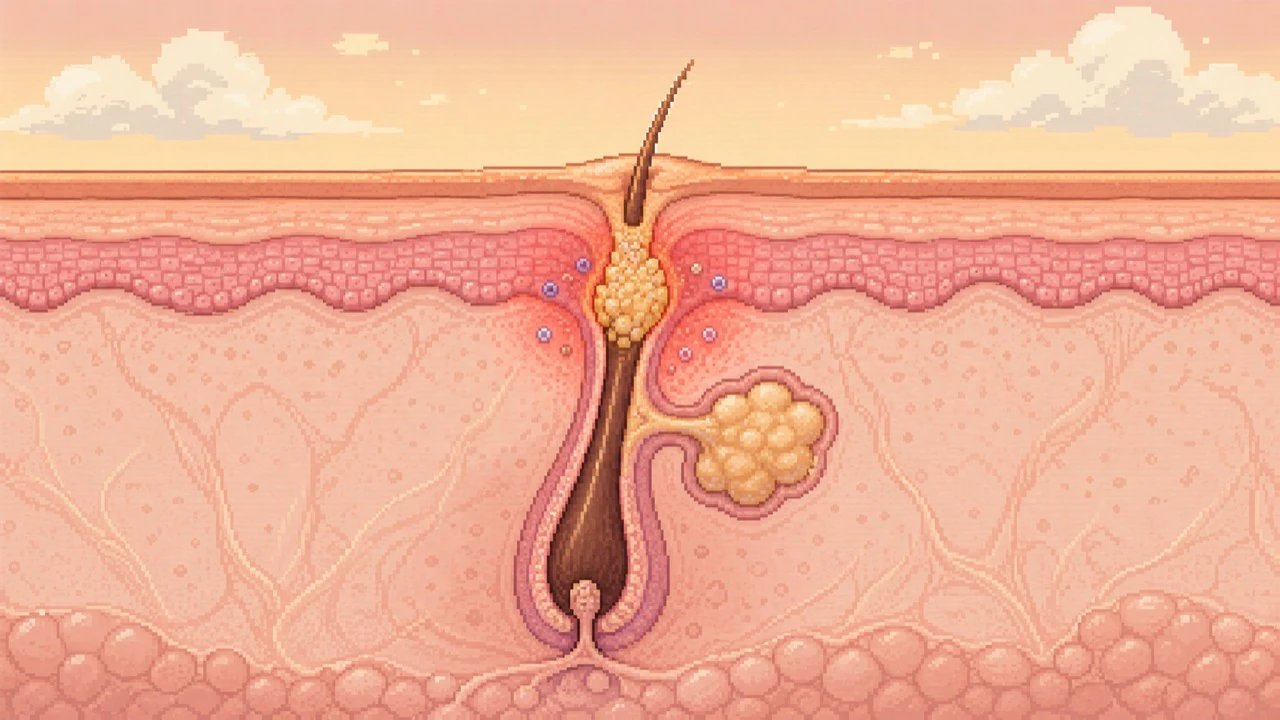
Acne is not dirt trapped in your skin, and it is not a personal failure. It begins inside hair follicles, where several normal parts of skin biology can start interacting in an acne-prone way.
That matters because the usual story says that oil plus dead skin cells clog a pore, bacteria arrive, and inflammation follows. It sounds like a clean four-step chain. Real acne is more complicated. Inflammation can be present before a spot is visible, Cutibacterium acnes is a normal resident of healthy skin, and hormones and genes influence how the whole follicle behaves.
The short version
What causes acne?
Acne develops when an acne-prone hair follicle plugs too easily, its oil-rich environment changes, resident microbes interact differently with the follicle and immune system, and inflammation builds. Hormones, genetics, medications, products, friction, and other individual factors can shift that balance. No single part explains every breakout.
Start with the follicle, not the surface
What we casually call a pore is usually the opening of a hair follicle. A sebaceous gland empties sebum into that follicle. Sebum is the skin’s normal oily mixture; it helps condition skin and hair. Cells lining the follicle normally shed and move toward the surface.
In acne-prone skin, those lining cells can collect instead of separating and exiting normally. Mixed with sebum, they form a microscopic plug called a microcomedo. You cannot see it yet, but it is the seed of a blackhead, whitehead, or inflamed lesion. Several processes are already interacting around it.
Four forces interact inside an acne-prone follicle
These are useful categories, not four stages. They overlap, feed back on one another, and matter in different proportions from person to person.
1. Follicular cells collect too easily
The lining of the follicle becomes “sticky” in a biological sense: cells shed differently, accumulate, and narrow or block the opening. This process is called abnormal keratinization. It is not the same as ordinary surface dirt, and scrubbing cannot reach or reverse it.
2. Sebum changes the environment
Androgens are hormones present in people of every sex, and they can stimulate sebaceous glands, especially around puberty and other hormonal shifts. The amount and composition of sebum can influence the follicle’s cells, microbes, and inflammatory signals. Oil is part of the environment, not “grime” and not proof that skin is unclean.
3. C. acnes behaves differently in the follicle
Cutibacterium acnes lives on healthy skin and can contribute to normal skin balance. Acne is not simply an infection caused by catching “bad bacteria.” What appears to matter is the follicular environment, the mix of microbial strains and communities, and how those microbes interact with a particular person’s immune system.
4. Inflammation is present early
Inflammation does not always wait until a clogged pore turns red. Studies of very early acne lesions have found inflammatory activity around follicles before or alongside microcomedo formation. As inflammation intensifies, a lesion may become red or purple, swollen, tender, or filled with visible pus. Deeper inflammation raises the risk of structural scarring.
Why two people can use the same product and get different results
Genes influence sebaceous glands, inflammatory responses, follicular behavior, and the tendency to scar. Hormonal sensitivity and the local skin microbiome also vary. The same ingredient can therefore help one person, irritate another, or address only one part of a mixed acne pattern.
Why acne does not always look the same
Acne lesions describe what the follicle is doing; they are not a required progression. One person can have several types at the same time.
Blackheads and whiteheads
A blackhead is an open comedo. The exposed material at the follicular opening darkens at the surface; the color is not dirt. A whitehead is a closed comedo: the opening remains covered, producing a small skin-colored or pale bump.
Papules and pustules
A papule is an inflamed, solid bump. A pustule has visible pale or yellow-white fluid. Pus reflects inflammation and immune cells; it does not automatically mean a contagious infection.
Nodules and “cystic” acne
Deep, tender lesions are often called cystic acne in everyday language. Many are inflammatory nodules rather than true cysts. Whatever the label, a painful lump beneath the surface deserves earlier attention because deep inflammation is harder to treat with over-the-counter products and more likely to scar.
Acne myths worth dropping
- “Acne means your skin is dirty.” Acne forms inside follicles. Repeated washing and scrubbing can irritate the skin without fixing abnormal plugging.
- “A blackhead is dirt.” Its exposed surface material darkens, but the color is not dirt or evidence of poor hygiene.
- “Only teenagers get acne.” Acne can begin, continue, or recur in adulthood. Hormonal transitions can matter, but adults of any sex can develop it.
- “Chocolate or dairy is the root cause.” Some studies suggest an association between acne and higher-glycemic dietary patterns, but randomized and other interventional evidence remains limited and conflicting. Dairy associations have also been reported, largely in observational studies, but the evidence is not sufficiently consistent to routinely prescribe dairy avoidance. Current acne guidelines do not support one universal restrictive “acne diet.”
- “You should dry acne out.” Irritated, peeling skin is not proof that a product is working. Excess irritation can make a routine harder to sustain and can prolong post-inflammatory color change.
- “Location tells you the hormonal cause.” Jawline flares can occur with hormonal shifts, but a face map cannot diagnose hormones, organs, or the cause of an individual breakout.
What can shift acne in one direction or another?
- Hormonal changes and sensitivity: Puberty, menstrual cycles, pregnancy, menopause, and some hormone-related conditions or medications can alter acne. Location alone is not a diagnosis.
- Skin and hair products: Oils, waxes, and other ingredients can contribute to comedones where products contact the skin. “Non-comedogenic” or “won’t clog pores” is a useful starting label, not a guarantee for every person.
- Friction, pressure, and occlusion: Helmets, straps, tight athletic gear, masks, and repeated rubbing can aggravate follicles. Sweat itself is not dirty; gently cleansing after sweating and reducing repeated friction can help.
- Stress: Stress is not considered a single root cause of acne, but it can worsen acne in someone who is prone to it. That is an aggravating factor, not a reason to blame yourself for being stressed.
- Diet: A repeatable personal pattern can be worth discussing, but broad elimination diets can add nutritional and emotional burden without reliably clearing acne. Diet should not replace effective care.
- Medications and supplements: Corticosteroids, testosterone or anabolic steroids, lithium, and some other products can trigger acne-like eruptions. Do not stop a prescribed medication on your own; bring the timing to the prescriber’s attention.
Is “fungal acne” really acne?
Usually, “fungal acne” refers to Malassezia folliculitis, an inflammation of hair follicles involving Malassezia yeasts that normally live on skin but can participate in folliculitis under favorable conditions. It is not acne vulgaris. It can cause clusters of similar-looking, often itchy bumps on the forehead, hairline, chest, shoulders, or back and usually lacks blackheads and whiteheads. Because several rashes can look alike, persistent itchy or very uniform bumps are a reason to confirm the diagnosis rather than keep adding acne products.
How common over-the-counter ingredients map to the biology
These ingredients are tools, not a universal routine. The useful choice depends on the lesions you have, your skin’s tolerance, what else you use, and whether pregnancy, age, eczema, medication interactions, or another diagnosis changes the plan.
- Adapalene and other topical retinoids help normalize how follicular cells shed and also reduce inflammation. They are useful across comedonal and inflammatory acne, but dryness and irritation can occur early.
- Benzoyl peroxide reduces acne-associated bacteria and helps inflammatory lesions. It can irritate skin and bleach fabric. It is also commonly paired with topical or oral antibiotics in clinical care to help limit antibiotic resistance.
- Salicylic acid helps loosen and prevent material within clogged follicles. It can be useful for blackheads and whiteheads, but stacking it with several exfoliating products can create more irritation than benefit.
- Azelaic acid can help follicular plugging and inflammation and may also help post-inflammatory dark marks. Strength, formulation, and tolerance matter.
Start with a simple question: which part of the pattern are you trying to change? Introduce one meaningful change at a time, follow that product’s Drug Facts label, and expect improvement to take weeks rather than days. Constantly switching products makes both irritation and results harder to interpret.
Pregnant, trying to conceive, or breastfeeding?
Do not assume an over-the-counter acne product is automatically appropriate. Most experts recommend stopping adapalene and other topical retinoids during pregnancy. Ask your obstetric clinician or dermatologist about a safe plan before starting or continuing treatment; breastfeeding and where a product is applied can also change the advice.
A reasonable self-care foundation
- Cleanse gently. Wash acne-prone skin up to twice daily and after sweating with a mild cleanser and your fingertips. Skip harsh scrubs and repeated washing.
- Keep the routine tolerable. A non-comedogenic moisturizer can reduce dryness from acne treatment. Add a non-comedogenic broad-spectrum sunscreen, especially when irritation or post-inflammatory color change is a concern.
- Choose one active for a clear reason. Follow the label. More products, higher percentages, and more burning are not automatic upgrades.
- Give it enough time. Many routines need about six to eight weeks for early improvement and longer for fuller control. Deep or scarring acne should not wait on a prolonged drugstore experiment.
- Try not to pick, but don’t turn it into a moral test. Picking is understandable, especially when a lesion hurts or feels impossible to ignore. Picking can traumatize the follicle and surrounding skin, prolong a lesion, and increase the chance of post-inflammatory color change and scarring. Pimple patches or simply covering a tempting spot can provide a physical reminder.
A flat mark is not always a scar
Post-inflammatory color change
After a lesion flattens, it may leave a post-inflammatory color change. Some marks are predominantly vascular, often appearing pink, red, or purple and described as post-inflammatory erythema. Others are predominantly pigmentary, often appearing brown, gray, or darker than the surrounding skin and described as post-inflammatory hyperpigmentation. The two can coexist, and their appearance varies with skin tone; neither is a structural scar. They often fade, but the process can take months. Pigmentary alteration can be particularly prominent or persistent in more deeply pigmented skin.
Structural acne scars
A scar changes texture: it may be indented, tethered, thickened, or raised. Treating active acne early helps reduce the chance of new scars. Existing scars usually require a different conversation than active breakouts or flat marks, so “scar products” and acne products should not be treated as interchangeable.
When Acne 101 stops being enough
You do not have to earn dermatology care by failing every product on a store shelf. A formal evaluation can be useful when:
- lesions are deep, painful, or rapidly worsening;
- new indented or raised scars are forming;
- flat marks are persistent or as concerning as the active acne;
- a consistent over-the-counter approach has not produced meaningful improvement;
- products cause significant burning, swelling, crusting, or another rash;
- the bumps are unusually itchy, very uniform, or may be rosacea, folliculitis, perioral dermatitis, or a medication-related eruption;
- acne is affecting sleep, school, work, relationships, confidence, or mental health.
A clinician can confirm what the lesions are, look for scarring and contributing factors, and decide which mechanisms actually need treatment. The goal is not simply to prescribe something “stronger.” It is to build a plan that fits the acne pattern, health history, tolerance, and priorities.
Learn what an acne evaluation can clarify
Scenic Dermatology’s acne treatment page explains how diagnosis, breakout type, scarring risk, prior treatment, and individual goals shape a clinical plan.
Acne FAQ
Can acne be hormonal if it is not on the jawline?
Yes. Hormones can influence sebaceous glands and follicular behavior anywhere acne develops. A jawline pattern may be a clue in some people, but location alone cannot confirm a hormonal cause or diagnose a hormonal condition.
Does “purging” mean an acne product is working?
Not always. A topical retinoid such as adapalene can make acne seem worse during the first weeks as existing microcomedones become visible, and early dryness is common. Burning, swelling, crusting, an itchy rash, or breakouts in completely new areas are not reasons to keep pushing through. Follow the label and get advice if the reaction is significant or persistent.
Should I stop using benzoyl peroxide because of benzene?
Benzoyl peroxide remains a guideline-supported acne treatment. In 2025, the FDA tested 95 marketed benzoyl peroxide acne products; more than 90% had undetectable or extremely low benzene levels, while six had elevated levels that led to voluntary retail-level recalls. The FDA characterized the estimated individual cancer risk from the detected levels as very low, even with decades of daily use. These findings do not support telling everyone to discontinue benzoyl peroxide. Check the current FDA recall page and your product’s expiration date, follow storage directions, avoid excessive heat, and ask a clinician about alternatives if you remain concerned.
Can acne marks fade without scar treatment?
Flat color changes often fade over time and are not structural scars, although fading can be slow. Indented, tethered, thickened, or raised areas reflect a change in texture and are scars. Preventing new inflammation, avoiding picking, and using sun protection can help limit additional color change while a clinician sorts out active acne and any scar treatment separately.
Sources
- Journal of the American Academy of Dermatology: 2024 guidelines of care for the management of acne vulgaris
- American Academy of Dermatology: Acne—who gets it and causes
- American Academy of Dermatology: Acne signs and symptoms
- American Academy of Dermatology: Tips for managing acne
- American Academy of Dermatology: Acne treatment during pregnancy
- American Academy of Dermatology: Can the right diet get rid of acne?
- JAAD International: Diet and acne—a systematic review
- Journal of Drugs in Dermatology: The sequence of inflammation, relevant biomarkers, and the pathogenesis of acne vulgaris
- American Journal of Clinical Dermatology: The skin microbiome as an actor in inflammatory acne
- American Journal of Clinical Dermatology: The pathogenesis and management of acne-induced post-inflammatory hyperpigmentation
- DermNet: Malassezia folliculitis
- U.S. Food and Drug Administration: Benzoyl peroxide product testing and limited recalls